Shipping an LLM-powered feature is no longer the hard part. The hard part is knowing whether it actually works — consistently, safely, and at a cost that makes sense. For applications with agentic logic, where the model makes multiple decisions, calls tools, and produces emergent behavior, the question becomes even sharper: how do you measure something that doesn't have a single right answer?
Traditional software testing assumes deterministic outputs. LLM applications break that assumption on day one. A prompt that worked yesterday can fail today after a model upgrade. A retrieval step that looked solid in development can collapse in production when query patterns shift. Without a deliberate benchmarking strategy, teams end up flying blind, relying on anecdotes and demo-driven optimism.
This guide lays out a practical approach to benchmarking LLM applications — what to measure, which tools have matured into serious options, and how to structure an evaluation workflow that survives contact with production.
Why traditional testing isn't enough
LLM outputs are probabilistic, context-sensitive, and often correct in multiple valid ways. A summary can be excellent or terrible depending on what the reader needs. A tool-calling agent can reach the right answer through five different reasoning paths, some efficient and some wasteful. Unit tests with fixed assertions catch only the most obvious regressions.
Worse, the failure modes are subtle. Hallucinations appear in confident, well-formatted prose. An agent might solve the task but burn three times the expected tokens. A retrieval pipeline might return technically relevant documents that nevertheless miss the user's intent. None of these show up as exceptions in your logs.
Benchmarking, in this context, is less about pass/fail and more about building a measurement discipline — one that captures quality, cost, and behavior across many examples and tracks how those metrics evolve as you change prompts, models, or tools.
What to measure
Before reaching for tools, decide what you actually care about. For most production LLM applications, the meaningful dimensions cluster into four groups.
Task outcomes. Did the system achieve what the user asked for? This is the headline metric. For closed-ended tasks (classification, extraction, routing), you can often grade automatically against a labeled dataset. For open-ended tasks (writing, reasoning, multi-step problem solving), you'll need either human review or an LLM-as-judge approach with a clear rubric.
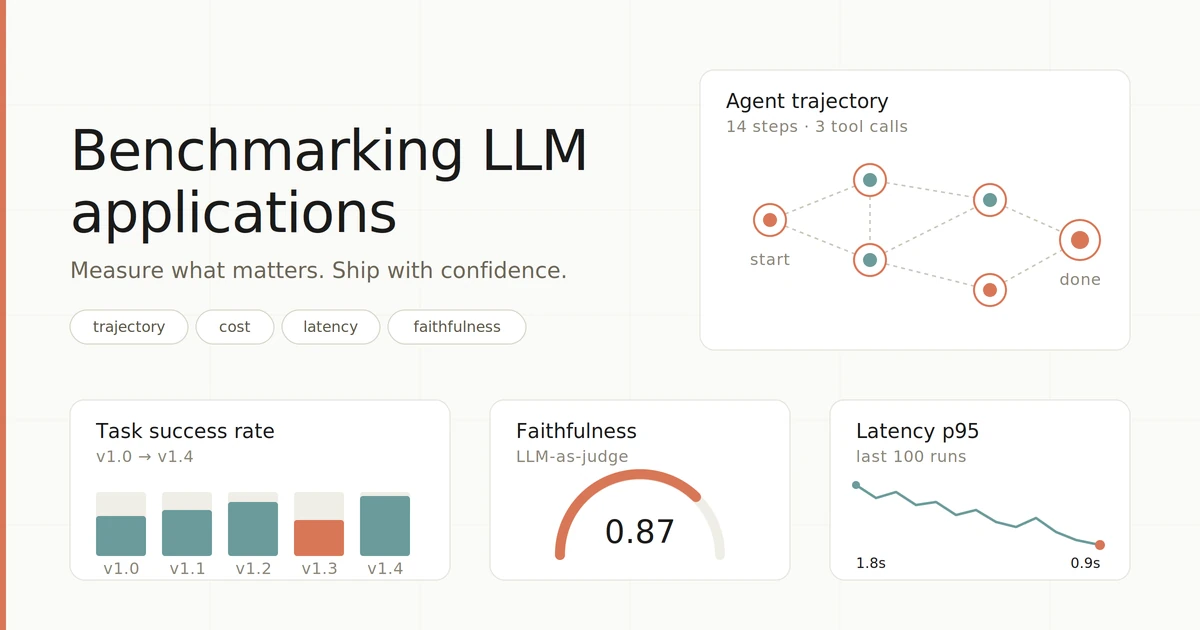
Trajectory quality. For agentic systems, the path matters as much as the destination. Did the agent call the right tools in a sensible order? Did it loop unnecessarily? Did it stop when it should have? Trajectory metrics catch problems that outcome metrics miss — an agent that gets the right answer after twelve redundant tool calls is a production incident waiting to happen.
Cost and latency. Token consumption, number of model calls, and wall-clock time per request. These compound quickly. A 20 percent regression in average tokens per task can erase the margin on a paid feature. Latency budgets are especially tight for interactive use cases, where each extra second of "thinking" pushes users toward abandonment.
Robustness. How does the system behave on edge cases, adversarial inputs, ambiguous queries, or when a tool returns garbage? Robust systems degrade gracefully. Fragile ones produce confident nonsense. A serious benchmark suite includes deliberate stress cases, not just the happy path.
For systems with retrieval-augmented generation (RAG), add component-level metrics: retrieval precision and recall, context relevance, and faithfulness of the final answer to the retrieved documents. Problems in RAG pipelines almost always trace back to retrieval, and surfacing this separately saves enormous debugging time.
The tooling landscape
A handful of platforms have matured into credible choices. None of them is universally correct — the right pick depends on your stack, your appetite for self-hosting, and whether your team values experiment tracking or production observability more.
For end-to-end evaluation and tracing, LangSmith offers tight integration if you use LangChain or LangGraph, but works with any Python stack. Langfuse is the open-source alternative, self-hostable, with strong tracing and dataset workflows. Arize Phoenix takes an OpenTelemetry-based approach that avoids vendor lock-in and shines for production observability combined with offline evaluation. Braintrust focuses on eval-driven development and has a particularly clean experiment comparison interface.
For pytest-style assertions and CI integration, DeepEval brings familiar testing patterns to LLM outputs, with built-in metrics for hallucination, faithfulness, and contextual precision. Promptfoo uses YAML-driven configuration and excels at prompt regression testing and quick A/B comparisons.
For RAG specifically, Ragas has become the de facto standard, with metrics tailored to retrieval-augmented systems: faithfulness, answer relevancy, and context precision and recall.
For research-grade evaluation suites, OpenAI Evals and the UK AISI's Inspect AI offer more structured frameworks aimed at systematic capability testing.
For agent-specific benchmarking, public benchmarks like SWE-bench, WebArena, τ-bench, and GAIA are less about plugging into your application directly and more about offering reference designs for what good agent evaluation looks like. Studying their task structures is useful even if you build your own suite.
The pragmatic starting move is to choose one tracing platform (LangSmith, Langfuse, or Phoenix) and one assertion-style framework (DeepEval or Promptfoo). Adding more tools later is cheap; adopting none and trying to roll everything yourself is expensive.
A workflow that holds up in production
Tools alone don't produce reliable systems. The workflow around them does. The approach that works for most teams looks roughly like this.
Start with instrumentation. Before optimizing anything, capture traces of real interactions — inputs, intermediate steps, tool calls, final outputs, and metadata like tokens and latency. You cannot improve what you cannot see, and most teams discover that their mental model of what their agent does diverges sharply from what it actually does.
Next, build a golden dataset of fifty to a few hundred representative examples. Quality matters more than quantity. These should cover your real distribution of use cases, including the awkward ones. Annotate each example with what success looks like — not just the expected output, but the expected behavior (which tools should be called, how many steps, what constraints apply).
Then layer in evaluation metrics. Use deterministic checks wherever possible — schema validation, regex matches on tool names, exact-match on structured fields. They are cheap, fast, and don't drift. For semantic quality, use LLM-as-judge with a strong, pinned model and a precise rubric. Judge drift is real: if you let the judge model or its prompt change silently, your benchmark scores become meaningless over time.
For agentic systems, evaluate components before the whole. If the agent fails end-to-end, you want to know whether the failure was in routing, retrieval, tool selection, or final synthesis. Component-level metrics make failures localizable. End-to-end metrics tell you the system is broken but not why.
Wire the evaluation into continuous integration. Every prompt change, model swap, or significant tool update should trigger the suite. Treat regressions the way you treat broken builds — as something to investigate before merging. Track scores over time so you can see slow drift, not just sudden breakage.
Finally, expand the suite as you learn. Production incidents become test cases. User complaints become labeled examples. Edge cases discovered in the wild become regression tests. A benchmark suite that doesn't grow with the product becomes a snapshot of what mattered six months ago.
Avoiding the common traps
A few patterns derail LLM benchmarking efforts more than others.
Optimizing for the benchmark instead of the product is the classic one. If your eval suite rewards verbose, well-hedged answers, you'll end up shipping verbose, well-hedged answers — even when users wanted something direct. Periodically audit whether your benchmark still reflects what users actually need.
Trusting LLM-as-judge without validation is another. Judge models have biases, preferences for certain phrasings, and quirks that can systematically distort scores. Spot-check judge decisions against human reviewers, especially when launching a new metric.
Ignoring cost and latency until late is the third. It's easy to optimize quality in isolation and discover, just before launch, that the system is unaffordable or too slow. Track cost and latency from day one, even if you're not yet enforcing budgets.
And finally, treating benchmarking as a one-time setup rather than an ongoing practice. The systems that stay reliable in production are the ones whose teams treat evaluation as a permanent part of the engineering loop, not a phase that ends when the feature ships.
Where to start
If you're early in this journey, the smallest useful step is to instrument your application, hand-curate twenty to fifty real examples, and set up a single end-to-end evaluation that runs on every change. That alone puts you ahead of most teams shipping LLM features today.
From there, the path is incremental: add component-level metrics, expand the dataset, automate the regression suite, and grow the evaluation harness alongside the product. Benchmarking LLM applications is not a project with a finish line. It is the engineering discipline that separates AI features that work in demos from AI features that work in production.